Horticulture
Last updated: May 18, 2026
Farming in Rust is a deep system masquerading as "plant seed, water, eat." Every plant has six gene slots, every gene has a weight in the crossbreeding math, and the difference between a junk clone and a max-yield clone is the difference between feeding yourself and out-farming a clan. This file is how to win at plants.
The system rewards patience: it takes 6+ hours real-time to grow a plant to ripe, and good genetics take multiple generations of crossbreeding to lock in. But once you have a YYYYYY pumpkin  clone line, you feed your base forever for the cost of fertilizer
  and water.
The gene system
Every seed has 6 gene slots. Each slot holds one of five gene types:
| Gene | What it does | Color | Weight |
|---|---|---|---|
| G | Growth speed (faster) | Green | 0.6 |
| Y | Yield (more output per plant) | Green | 0.6 |
| H | Hardiness (survives bad conditions) | Green | 0.6 |
| W | Water intake — drains water faster | Red | 1.0 |
| X | Empty/null gene — does nothing | Red | 1.0 |
You read gene strings left to right: "GGYYHX" means slot 1 is G, slot 2 is G, etc.
Strong gene strings:
- YYYYYY — six yield. Maximum output per plant. Slow grow, normal water. Endgame.
- GGYYYY — fast grow with high yield. The "all-rounder" pumpkin string.
- GGGYYY — fastest grow with decent yield. Good for hemp  where you want cloth
  fast.
- YYYYYG — five yield + one growth. Slightly faster than YYYYYY, ~95% the yield.
fast.
- YYYYYG — five yield + one growth. Slightly faster than YYYYYY, ~95% the yield.
Bad gene strings: - WWWWWW — all water intake. Plant dies fast. - XXXXXX — all empty. Plant grows but produces nothing useful. - Any mix with 3+ red genes (H, W, X) is generally junk because of how crossbreeding weights work.
Each gene in full
The system has six gene slots and five possible gene types. There is no sixth gene type — the "6-gene system" name refers to the six slots, each of which independently holds one of G / Y / H / W / X. Here is exactly what each does:
- G — Growth. Each G shortens the time the plant spends in every growth stage. A full GGGGGG plant grows roughly 35% faster than a string with no G. G affects nothing else — it does not change yield or water use.
- Y — Yield. Each Y raises the harvest amount (cloth, fruit, seeds, clones). Six Y is the single biggest output multiplier in the game; a YYYYYY plant produces meaningfully more per harvest than any other string.
- H — Hardiness. Each H raises tolerance to temperature and dehydration stress. Useful only when conditions are bad — in a controlled indoor greenhouse, H does nothing a heater and sprinkler do not already do, so most farmers treat H slots as wasted potential.
- W — Water intake. A genuinely harmful gene. Each W makes the plant drink water far faster — a WWWWWW plant empties a planter several times quicker than a plant with zero W. It gives no benefit at all.
- X — Empty. A dead slot. X does not hurt the plant directly the way W does, but every X is a slot that could have been a Y or G. X is "neutral-bad": harmless but a pure waste.
Gene weights: good vs bad
The crucial split for breeding is not "good gene vs bad gene" — it is the weight each gene carries when slots fight during a cross. Verified identical across rustgenetics.com and corrosionhour.com:
| Gene | Category | Crossbreed weight | Want it? |
|---|---|---|---|
| G | Green | 0.6 | Yes |
| Y | Green | 0.6 | Yes |
| H | Green | 0.6 | Situational |
| W | Red | 1.0 | No |
| X | Red | 1.0 | No |
Note the trap: H is a good gene (green, 0.6 weight) but W and X — the genes you do not want — carry the higher 1.0 weight. This is deliberate. It means bad genes are "stickier" and harder to breed out, which is why crossbreeding has to be done with clean, good-gene parents only.
Reading a gene string
A gene string is six letters read strictly left to right, one per slot. GGYYHX means slot 1 = G, slot 2 = G, slot 3 = Y, slot 4 = Y, slot 5 = H, slot 6 = X. Slot position matters during crossbreeding because each of the six slots is resolved independently — slot 3 only ever fights slot 3 on the neighbouring plants, never slot 1 or slot 5. To grade a string at a glance: count the greens (G/Y/H) versus reds (W/X). Six greens is excellent; four or more reds is junk you should discard rather than try to fix.
Crossbreeding — the actual math
Crossbreeding is how you turn random seeds into your target gene string. It works at one specific stage of plant growth (the Crossbreed stage), where adjacent plants in a planter exchange genes with each other.
The weight rule
When two plants are at the crossbreed stage and adjacent, each gene slot is rolled. Each plant contributes a vote on what gene should occupy that slot in the offspring. Red genes (W, X) have weight 1.0. Green genes (G, Y, H) have weight 0.6. Donor genes overwrite the center plant only if the combined weight strictly exceeds the center plant`s. (Note: H is green/good, not red — the old "red beats green 2-to-1" rule was a simplification.)
This sounds backwards — why do bad genes have higher weight? Because Facepunch wanted RNG protection. If you plant a YYYYYY (clone, all green) next to a junk WWWWWW (all red), the offspring biases toward red because each red gene out-votes each green gene 2-to-1.
The implication: you cross good plants with good plants, never good plants with junk plants. And the cleanest crosses are with target strings that are themselves clean.
How to actually cross
- Find a seed with at least one Y or G gene. Plant it.
- Plant another seed (or clone) with a different Y or G gene in a different slot. Adjacent in the same planter.
- Wait for the crossbreed stage (around 50–60% growth).
- The plants exchange. The offspring seed from the crossbreeding will likely have a mix of both parents' genes.
- Take cuttings (clones) from the best offspring.
The cleanest way to lock in a YYYYYY string is: - Generation 1: cross Y???? with Y???? → offspring with YY???? (some) - Generation 2: cross YY???? with YY???? → offspring with YYY??? (some) - ... continue until you reach YYYYYY.
This takes 4–6 plant cycles, about 24–36 hours of real-time wipe. Worth every minute.
RustBreeder and other tools
RustBreeder.com is a free web tool that simulates the crossbreeding math. Plug in your current plants' genes and target string, and it tells you which combinations have the highest probability of advancing. Use it. The math is not intuitive enough to do in your head reliably.
Other tools: rustlabs.com has the gene reference and growth times. GeneRust is a Discord-based bot some servers use. Pick one and stay consistent.
Cloning
Once you have a great-genes plant, you take cuttings (G key on a ripe plant). A cutting plants a clone — same gene string, instant. Cuttings don't crossbreed (they're already locked-in). So your endgame is a planter of 9 identical YYYYYY clones, all cropping at the same rate, all delivering max yield.
The 3x3 cluster, slot by slot
Crossbreeding happens inside one large planter — a 3x3 grid of nine slots. The plant in the centre is the defender; the up to eight plants around it are donors. At the instant every plant in the cluster reaches the Crossbreed stage, the game runs six independent contests — one per gene slot. Slot 1 of the centre is challenged only by slot 1 of each donor, slot 2 by slot 2, and so on.
For one slot the resolution is:
- For each possible gene, sum the weights of every donor carrying that gene in that slot (G/Y/H = 0.6 each, W/X = 1.0 each).
- Find the gene with the highest donor total.
- That gene overwrites the centre only if its total is strictly greater than the centre's own gene weight. Equal is not enough — the defender wins ties against itself.
Weighted resolution, worked
Say the centre plant has G in slot 1. Around it, three donors carry G in slot 1 and one donor carries W there:
- G donor total: 3 x 0.6 = 1.80
- W donor total: 1 x 1.0 = 1.00
- Highest donor gene is G at 1.80. It must beat the centre's own G. Since the centre simply keeps G either way here, slot 1 stays G — clean.
Now the danger case: centre has Y in a slot, and two donors carry W there. W total = 2 x 1.0 = 2.00. To defend, the centre's Y would need help — but the centre is a single plant contributing a single 0.6. The W donors win and the slot becomes W. This is exactly why you never let a junk plant sit in the cluster: two reds can flip a good slot.
The tiebreak hierarchy
When totals are close, resolution follows a strict order:
- Highest combined weight wins the slot. Add up donor weights per gene; biggest number takes it.
- Strict-greater rule. A donor gene must exceed the centre's weight to overwrite it. Exactly equal means the centre keeps its gene — the defender always wins a draw.
- True donor-vs-donor tie. If two different donor genes reach the same top total (for example G at 1.2 versus Y at 1.2), the game picks one at random, a 50/50 coin flip for that slot.
Tied slots compound: two independent 50/50 slots means only a 25% chance both land the way you want. This randomness is why breeders run several donor plants and clone aggressively the moment a slot lands correctly, rather than re-rolling the whole string.
Generations to lock a god clone
A "god clone" is a fully clean target string — GGGYYY for fast hemp, YYYYYY for maximum-yield pumpkin or berries. Starting from random shop or wild seeds, expect 2 to 4 crossbreeding generations to push every red gene out and lock every green one in. Luck on your opening seed rolls swings this: a lucky GGGYY? start may lock in two generations, an all-junk start can take four or five. Each generation is one full plant cycle, so in real wipe time budget roughly 24-36 hours of plant growth — done in the background while you raid and farm. Once locked, you never gamble on a seed again: you only ever take cuttings from the god clone.
Cloning vs seeding
Two ways to start a new plant, and they behave very differently:
- Seeding — planting a seed. The seed's genes are fixed when it drops from a harvest, and seeds can crossbreed with neighbours. Seeds are how you change genetics: every breeding generation runs on seeds.
- Cloning — taking a cutting from an existing plant (the cutting/clone action on a sapling or grown plant). A clone is a perfect copy of its parent's gene string and cannot crossbreed — its genes are locked. Cloning hemp or berries returns three cuttings per plant; food crops (corn, pumpkin, potato) return two. Cloning is how you mass-produce a string you have already perfected.
The rule of thumb: seed while you are still improving the genes, clone once they are perfect. Never clone a flawed string — a clone of YYYYYG is permanently YYYYYG and can never be bred upward.
Growth stages
Every plant goes through six stages:
| Stage | What's happening | What you can do |
|---|---|---|
| Seedling | Just planted | Wait. Don't disturb. |
| Sapling | Visible green sprout | Wait. |
| Crossbreed | Mid growth, ~50–60% | THIS is when genes swap with adjacent plants. |
| Mature | Fully grown but not fruiting | Wait. |
| Fruiting | Producing fruit | Harvest available. |
| Ripe | Maximum yield ready | Harvest now or it starts dying. |
| Dying | Past ripe, yield declining | Harvest before total death. |
The Crossbreed stage is the only window where adjacent-plant genetics transfer. After that stage, the plant's offspring genes are locked.
Growth times depend on the plant. Approximate times for a YYYYYY clone with good conditions:
- Hemp : 4–5 hours seed to ripe
- Pumpkin : 6–7 hours seed to ripe
- Corn
 : 6–8 hours seed to ripe
 - Potato: 6 hours seed to ripe
- Berries
 (red/yellow/blue/white/green/black): 4–6 hours seed to ripe
G genes speed this up. A GGGGGG plant grows about 35% faster than an XXXXXX.
Stage-by-stage detail
The plant info panel always shows a percentage for the current stage, so you never have to guess. Exact durations scale with G genes, light and water, but the relative shape of the lifecycle is constant. For a fast GGGYYY hemp clone under a ceiling light and full water, rough figures are:
| Stage | Approx. time | Key action |
|---|---|---|
| Seedling | 1-2 min | Just planted. Leave it alone. |
| Sapling | ~11 min | Clone window opens — take up to 3 cuttings here. |
| Crossbreed | ~2 min | The only gene-swap window. Cluster must be ready. |
| Ripening | ~20 min | Mass builds, yield climbs. |
| Fruiting | ~30 min | Fruit/cloth forms; needs 100% light now. |
| Mature (ripe) | peak | Maximum yield — harvest immediately. |
| Dying | ~10 min | Yield decays. Harvest before total death or lose the crop. |
Total seed-to-ripe for that hemp build is roughly 100-110 minutes; slower strings and food crops run several hours. Two timing facts matter most: the Crossbreed window is only about two minutes, so the whole cluster must hit it together or the generation is wasted; and the Dying stage is a hard deadline — a ripe plant left unattended loses yield and then dies, taking its seeds and clones with it. Set a mental or in-game timer around the ripe mark.
Planters
You can't plant in the ground. You need a planter.
Small planter
Cost: 100 wood  + 1 tarp
  . No workbench required.
Slots: 3 plants (corrected from older docs that said 4).
Water capacity: 9,000 mL.
. No workbench required.
Slots: 3 plants (corrected from older docs that said 4).
Water capacity: 9,000 mL.
Wipe-day starter planter. Cheap, fits anywhere, but you can only fit 3 plants per planter so it's slow to scale.
Large planter
Cost: 200 wood + 2 tarp . No workbench required.
Slots: 9 plants (3x3 grid inside the planter).
Water capacity: 9,000 mL.
The standard. Buy from Bandit Camp for 30 scrap  if you don't want to craft.
Pro tip: large planters 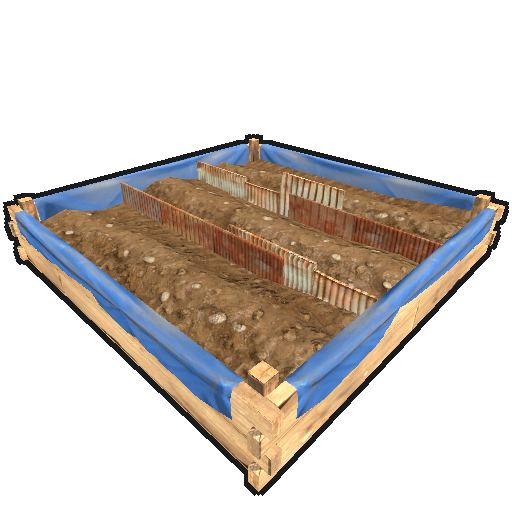 in a 3x3 grid of large planters = 81 plants in a single greenhouse room. That's enough hemp for unlimited cloth , enough pumpkin to feed a clan.
Where to place planters
Indoors with a sealed roof prevents weather damage but eliminates rain water (you have to water manually or with sprinklers). Outdoors gets rain water automatically but plants take temperature damage in cold/hot biomes.
Best of both: indoor placement under a glass roof / triangle frame piece. Or a half-roof so half the planter catches rain and the other half is sheltered.
Small vs large planter — the numbers
Side by side, the large planter wins on almost every metric. The only thing the small planter has going for it is a lower wipe-day cost.
| Spec | Small planter | Large planter |
|---|---|---|
| Plant slots | 3 (1x3 row) | 9 (3x3 grid) |
| Craft cost | 100 wood + 1 tarp | 200 wood + 2 tarp |
| Workbench | None | None |
| Water capacity | ~2,000-3,000 mL | 9,000 mL |
| Crossbreeding | Row only — no centre defender | Full 3x3 cluster (1 centre, 8 donors) |
| Bandit Camp price | n/a | ~30 scrap |
The 3x3 layout of the large planter is not just bigger — it is the only shape that gives you a true centre slot surrounded by eight donors, which is what the crossbreeding math assumes. A 1x3 small planter has no centre, so it is poor for serious breeding. Use small planters as cheap wipe-day food plots; switch every breeding and production planter to large as soon as you can afford the metal.
Water
Plants drink water from the planter. Water capacity is 9,000 mL for large planter , 4,000 mL for small. Plants consume water based on their W (water intake) genes — a plant with 0 W genes drinks at normal rate; a plant with 6 W genes drinks 7x faster.
Refilling water
Three ways:
Rain — automatic if planter is exposed to open sky. Fills slowly during rain. Not reliable.
Manual water jug  refill — fill a water jug at a river, pour into planter. Annoying.
Sprinkler system — water source (pump/well) → pipe → sprinkler over planter. Automated.
Sprinklers
Cost: 75 frags  . Workbench 1
  .
Power: 5 rW per sprinkler.
Water draw: 2 mL/sec while spraying.
.
Power: 5 rW per sprinkler.
Water draw: 2 mL/sec while spraying.
A sprinkler placed over a planter waters all plants in the planter while powered. You connect it to a water source via fluid switch and pipe.
The whole system: 1. Pump jack or water pump pulls water from a river/lake into a pipe. 2. Pipes route water to your base. 3. Water purifier can convert salt water to fresh (large freshwater purifier needed for serious volume). 4. Liquid storage (water barrel, tank) buffers the water. 5. Fluid switch turns flow on/off via electrical signal. 6. Pipe to sprinkler over planter.
Common mistake: routing salt water (from ocean) directly to plants. Salt water resets a planter's moisture to zero and can kill plants. Always purify ocean water through a Large Water Purifier first. River water is fresh.
Indoor manual water cycle
Simpler setup if you don't want a full plumbing system: jug fills + manual pours. 1 jug = 5,000 mL = ~half a large planter . Time investment per day: ~2 minutes per planter. Fine for hobby farmers; insufficient for serious greenhouses.
Capacity, the sweet spot, and depletion
A large planter holds 9,000 mL. You do not want it full and you do not want it dry — soil saturation is what actually matters, and it sits at 100% as long as there is enough water in the reservoir. The practical sweet spot is 6,000-8,000 mL; below roughly 6,000 mL saturation begins to slide, and a dry planter stalls growth outright and starts cutting yield.
How fast the reservoir drains depends on the plants' W genes. A plant with zero W drinks at the base rate; a full WWWWWW plant drinks several times faster and can empty a planter while you are away on a single monument run. This is the hidden cost of red genes and another reason WWWWWW strings are junk. Initial planting also soaks water quickly — always top the reservoir up right after seeding a fresh planter.
Sprinkler and water-catcher math
A sprinkler placed over a planter waters every plant in it while powered. It draws about 2 mL/sec while spraying and roughly 70 mL per minute reaches a large planter beneath it. Source supply caps the system: a barrel or large water catcher feeds about 10 water units, which sustains a maximum of 5 sprinklers. As a rule of thumb one sprinkler comfortably keeps 2-3 large planters topped up. Water catchers fill passively from rain and morning dew, so a bank of catchers plus a buffer tank can run a greenhouse with no pump at all — slower, but raid-proof and free.
Light
Plants need light. Outdoors, sunlight handles this. Indoors, you need ceiling lights  aimed down at the planters.
Light requirements
A plant needs 100% light during fruiting stage to maximize yield. Less than 100% reduces yield. The game shows a percentage on the plant's info panel.
Indoor lighting:
- 1 ceiling light per large planter for 100% coverage. Aim down from directly above.
- Multiple lights add up if angled correctly. But adding 2 lights to a planter that already has 1 doesn't go past 100% — it's capped.
- Lights use 1–5 rW each (default 1).
Pro tip: indoor greenhouses are how clan farmers operate at scale. The plants have stable light, stable temperature, no weather, no raid exposure (the greenhouse is inside the main base). The only downside is the rW cost — 9 planters × 1 ceiling light each × 1 rW = 9 rW per greenhouse.
Temperature
Plants have temperature tolerance. Hot or cold biome puts plants under temperature stress, reducing yield. Indoor placement near a heater  (electrical heater, 2 rW) eliminates temperature stress in cold biomes. Hot biome plants don't need cooling.
H genes (hardiness) help — a high-H plant tolerates worse temperature, but H genes also use up gene slots that could be Y. The math usually favors Y-heavy strings + temperature management.
How light actually works
What a plant cares about is a light percentage shown on its info panel — the game converts the brightness landing on it into a 0-100% figure. You want 100% through the fruiting stage for maximum yield; anything less directly trims the harvest. Outdoors, daytime sunlight reaches 100% on its own, but night drops it to near zero — outdoor plants effectively only "work" during the in-game day, which is why outdoor farms are slow.
Indoors there is no day/night and no sun, so a light source is mandatory. A single ceiling light aimed straight down from directly above a large planter gives full 100% coverage for all nine plants. Light does not stack past 100% — bolting a second ceiling light onto a planter that already reads 100% changes nothing and just burns extra rW. Ceiling lights cost 1 rW each by default (adjustable up to 5). The takeaway: one ceiling light per large planter, centred and pointing down, and stop there.
Fertilizer
Plants don't strictly need fertilizer to grow, but fertilized plants yield more (~30% bonus).
How fertilizer works
The planter is itself a container. Walk up to a planter box and press the use key — just like opening a chest, it pops a storage UI. That UI is not only the 9 plant slots; it also has a dedicated fertilizer storage area. You do not hand-apply fertilizer to each plant one by one. Instead, you dump fertilizer into the planter's fertilizer slots and the planter manages distribution for you. Think of it like loading wood into a furnace: you fill the hopper, the machine burns it down on its own.
Once stocked, the planter automatically draws fertilizer from that shared storage and feeds whatever plants are growing in it. Each plant slot pulls independently from the common pool — a plant only consumes when its growth tick needs nutrients, so a slow-growing plant and a fast one each take what they need without you micromanaging. The practical effect: fertilized soil holds higher Nitrogen/Phosphorus/Potassium levels, which keeps soil quality near 100% and pushes growth speed and harvest yield up — community testing puts the combined boost at roughly 30% over an unfertilized plant. A seed also consumes one unit the moment it is planted (or the moment you first insert fertilizer into a planter that already has plants), so budgeting one unit per plant per full grow cycle is a safe rule of thumb.
When the planter's fertilizer storage runs dry, nothing breaks — the plants simply keep growing at the slower, unfertilized rate and miss the yield bonus until you restock. They will not die from lack of fertilizer (only lack of water or light kills them). So the practical loop is simple: keep the planter's fertilizer slots topped up, and the planter quietly feeds every plant inside it for you. Drop a stack in, walk away, and check back next cycle. Note that sprinklers only handle water — they never touch fertilizer, so refilling the fertilizer storage is the one manual chore that stays on your list.
How to get fertilizer
Horse  dung composter
  route: feed horse dung into a composter (200 wood + 2 tarp ). Ratio is 1:5 — 1 horse dung makes 5 fertilizer . This is by far the cheapest at-home source. Other materials (food, cloth , seeds) yield 0.2-0.3 fertilizer each.
Human poop composter route: yes, your character poops. Use the composter to convert human waste to fertilizer . Same ratio.
Bandit Camp / Outpost: buy fertilizer directly for scrap . Not the best deal but immediate.
Pro tip on horse dung
A single horse generates ~1 dung per ~15 minutes of standing in stable. A stable of 4 horses generates ~16 dung per hour. That's 80 fertilizer per hour passively (1:5 ratio). Stable + composter is a strong scrap -free farming setup for solos.
Scrap arbitrage
Horse dung composted into fertilizer can be sold at Bandit Camp. The exchange rate is roughly 2 fertilizer = 3 scrap . So 10 horse dung → 1 fertilizer → 1.5 scrap. A stable of 4 horses running 24 hours generates 16 dung/hr × 24 = 384 dung → 38 fertilizer → 57 scrap per day, passively.
More on this in 07_Scrap_Farming.md.
What to grow
| Plant | Use case | Recommended genes |
|---|---|---|
| Hemp |
Cloth (for clothing, sleeping bags  , bandages , bandages  ) ) |
GGGYYY or YYYYYY |
| Pumpkin |
Food, high calorie | YYYYYY or YYYYYG |
| Corn |
Food, decent calorie + farming seed source | GGGYYY |
| Potato | Food, low cost | YYYYYY |
| Berries (6 colors) |
Tea ingredients | YYYYYY |
Mushrooms  |
Health regen | (mushrooms grow in caves, not planters) |
Berries and tea
Berries are the highest-impact horticulture item because they craft into tea, which gives major buffs:
- Yellow + White berries → Scrap Tea: +100% (Basic) up to +350% (Pure) bonus scrap from BARRELS only, 30 minutes (Basic) up to 1 hour (Pure). The single best buff in the game for farming routes.
- Red berries → Health Tea: increases max health.
- Blue berries → pair into Wood Tea (2 Red + 2 Blue), Ore Tea (2 Yellow + 2 Blue), and Cooling Tea (2 White + 2 Blue).
- Green / Black berries → various other tea types.
A scrap -tea brewer who farms tea at home and drinks one before every monument run is doubling their effective scrap-per-hour.
To unlock tea crafting: research the Mixing Table 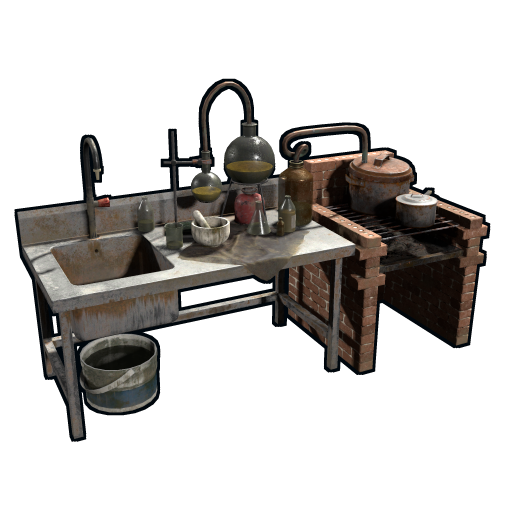 (Workbench 1 ). Then learn each tea recipe (each tea has a unique recipe).
Hemp economics
Hemp at scale is how clans never run out of cloth . A YYYYYY hemp plant yields ~12–15 cloth per harvest cycle. 9 plants per large planter × 4–5 planters × 4 cycles per day = 1,000+ cloth daily, passive. That's enough for unlimited bandages , sleeping bags , clothing, and even cloth-gated traps.
Yields, calories and what to prioritise
Different crops pay off in different currencies. Pick what to grow by what your base actually needs:
| Crop | Output | Per-unit value | Clones / harvest |
|---|---|---|---|
| Hemp | Cloth | ~12-15 cloth on a YYYYYY plant | 3 |
| Pumpkin | Food | ~100 calories, strong hydration + healing | 2 |
| Corn | Food | ~125 calories, weaker hydration/healing than pumpkin | 2 |
| Berries | Tea ingredient | Crafts into tea buffs — disproportionate value | 3 |
Reading the table: corn edges pumpkin on raw calories (125 vs 100) but pumpkin restores far more hydration and health per unit, so pumpkin remains the better all-round survival food. Hemp is the cloth engine — and it is the one crop that does not return seeds when consumed, so you keep hemp going purely by cloning. Food crops return seeds on consumption, so they self-perpetuate. Berries punch above their weight: a single planter of berries feeding a mixing table produces tea that effectively multiplies your scrap and survivability, which is why experienced farmers always keep a berry planter even when cloth and food are sorted.
Priority order for most players: hemp first (cloth gates everything), then berries for scrap tea, then pumpkin for food. Corn is a fine secondary food and a handy seed source while you breed.
Indoor greenhouse setup recipe
The clan-tier farming room:
- 3x3 floor space inside main base
- 9 large planters (1 per floor tile)
- 9 ceiling lights aimed down (1 rW each = 9 rW)
- 1 heater if cold biome (2 rW)
- 9 sprinklers (5 rW each = 45 rW) on a switched circuit
- 1 water purifier connected to a water pump or rain collector
- Composters (2–3) for fertilizer
- Optional: 4 horses outside in a stable for dung supply
Power draw: 56 rW continuous (lights+heater ) + 45 rW intermittent (sprinklers running)
Water draw: 18 mL/sec when sprinklers run (9 sprinklers × 2 mL/sec)
Output at YYYYYY hemp : ~1,500+ cloth /day. At YYYYYY pumpkin : ~250 pumpkins/day = 50,000+ calories.
Common mistakes
- Crossing junk with target. Junk genes (red, weight 2) will dominate. Cross good with good.
- Forgetting the crossbreed stage window. If you wait until plants are mature, you missed your chance.
- Watering with ocean water. Resets moisture, can kill plants. Filter through purifier.
- Skipping fertilizer . 30% yield bonus is too valuable to skip on a YYYYYY clone.
- Cloning before locking the gene string. A clone of YYYYYG is permanently YYYYYG. Lock YYYYYY first, then clone.
- Overlapping planters with light overlap > 100%. Doesn't help, wastes rW.
- Indoor greenhouse with no temperature control in snow biome. Temperature stress kills yield.
- Sprinkler running 24/7 without a switch. Wastes water — water has finite supply unless you have an active pump.
Pro tips
- Start your gene grind on hemp , not pumpkin . Hemp grows faster, so iterations are quicker. Once you have YYYYYY hemp , repeat the process for pumpkin using the technique you learned.
- Use RustBreeder before every cross. It tells you the probabilities. Free, browser-based, lightning fast.
- Always have 2 of each genome locked. If one dies (sprinkler malfunction, raider boot), you have a backup clone source.
- Place composters near the planter room. Reduces walk time when refilling fertilizer .
- The sprinkler switch should be on a timer
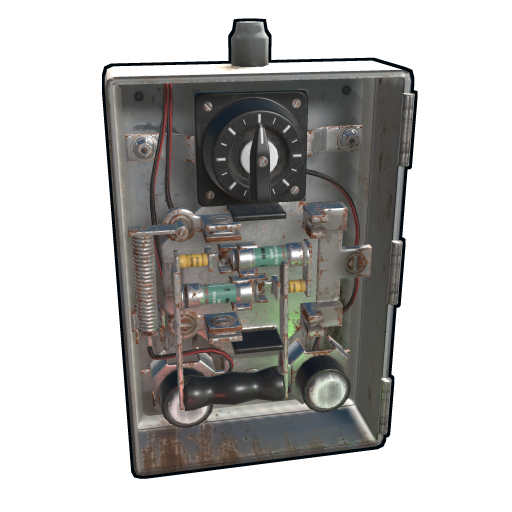 , not always-on. Water runs every 10 minutes for 30 seconds. Set with a timer logic gate.
 - Indoor greenhouse + auto-craft for tea (see
04_Industrial.md) = passive scrap-tea production while you play. - The Bandit Camp shop sells Large Planters for 30 scrap . Faster than gathering 200 wood early game.
- Pumpkin is the calorie king. One pumpkin = 70+ calories. A small stack of pumpkins feeds you for days.