Base Optimization for Production
Last updated: May 18, 2026
The other files cover how each system works in isolation. This file is how to wire them together inside your base to maximize output — scrap  per hour, ammo per hour, smelt rate, food yield — across solo, duo, trio, and clan scales.
The general rule: bigger isn't better, optimized is better. A well-tuned 2x2 out-produces a sprawling 4x4 that nobody finished building.
What "production" actually means
Five output metrics matter, by priority:
- Scrap throughput per hour — feeds research, blueprints, Bandit shop, tea ingredients
- 5.56 ammo
 per hour — feeds turrets
 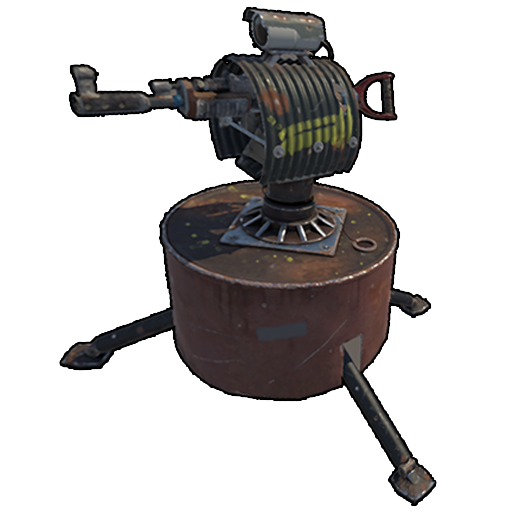 , raid ammo budget, PvP runs
 - Ingots per hour (metal frags
 + HQM
+ HQM  ) — fuel for crafting, repairs, walls
 - Food calories per day — keeps the team alive without daily hunting runs
- Tea per day — Scrap Tea, Health Tea, Anti-Rad Tea all multiply other outputs
You optimize for whichever metric is your current bottleneck. Out of ammo? Optimize the ammo chain. Always smelting? Add furnaces  .
.
Solo base (2x2 stone) — target outputs
A well-tuned solo 2x2 hits:
- 500+ scrap /hour active (monument runs + Bandit Camp scope arbitrage)
- 50 scrap /hour passive (horse
 dung composter
  + fertilizer
  arbitrage)
 - 150 rounds 5.56/hour from a 2-crafter
 ammo chain
 - 100 metal ore/hour smelted in a 3-furnace bank
- 3-5 cooked meat
 /hour from passive trap loops
Solo build priorities (in order)
- Hour 6-8: workbench 2
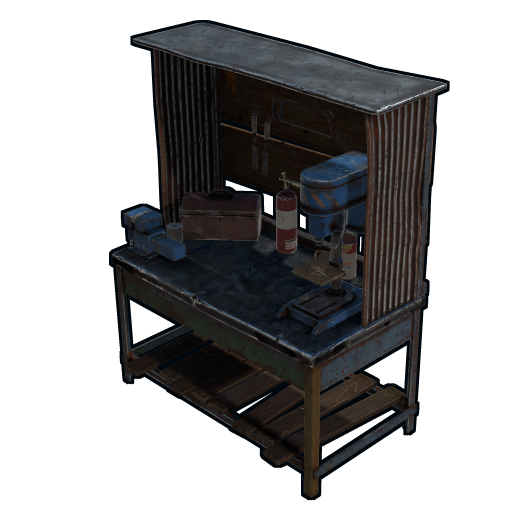 placed in hallway → unlock electric furnace
 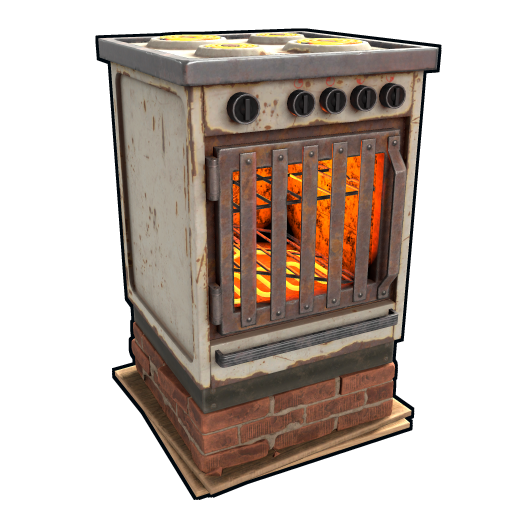 + auto turret
 - Hour 10-12: auto turret at front door + 1 large battery + 1 wind turbine
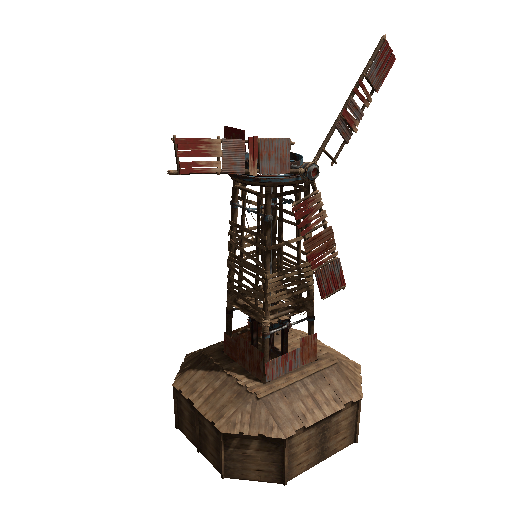 + 2 solar panels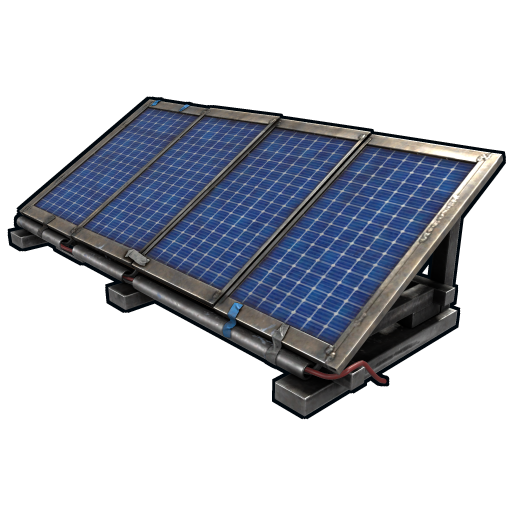
- Hour 14-16: electric furnace bank (3 furnaces ) replacing wood
 furnaces
 - Hour 16-20: workbench 3
 → unlock industrial network + crafter
 - Hour 20-24: 4-conveyor
 auto-sort + auto-recycler chain
 - Day 2: small greenhouse (3-4 planters) for hemp
 + berry
  teas
teas - Day 3: auto-craft chain (gunpowder
 → 5.56)
Solo power budget
Continuous loads: turret 11 rW + lights 4 rW + 4 conveyors 8 rW + 2 crafters 4 rW = 27 rW continuous.
Peak (with smelting): + 3 furnaces × 60 rW = 207 rW peak.
Source: 1 wind turbine on a 5-foundation pillar (~120 rW peak) + 2 solar panels (~30 rW peak) + 1 large battery (24,000 rWm storage). Smelt during daylight only; battery handles nighttime continuous load.
Duo base (2x2 or 3x2) — target outputs
The duo's advantage isn't size, it's parallel workflows. One person farms while the other recycles. One sleeps while the other plays.
A duo with this division of labor produces ~1,200 scrap per hour combined plus a sustained ammo/tea stream — roughly 2.4x a solo's output for 2x the players. The multiplier comes from no idle time: someone is always producing.
Duo build priorities
Same first-day path as solo (above), but with these adjustments by day 2:
- 3x2 layout with the extra bay dedicated to the greenhouse
- 8 large planters
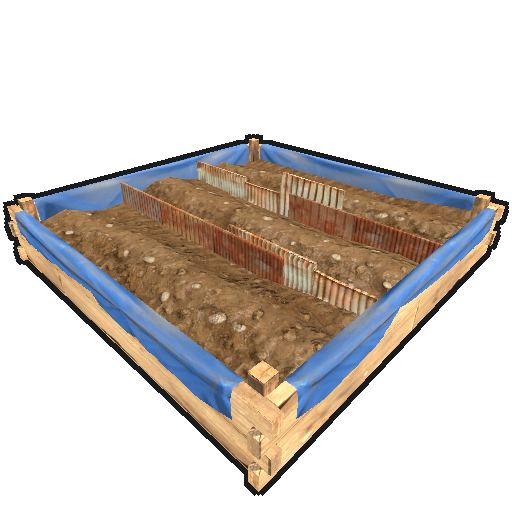 minimum — 2 hemp , 2 pumpkin
  , 4 berries (1 of each color)
 - 2 furnace banks running in parallel (smelt + bone refinery)
- Secondary sleeping arrangement offset by 6-8 hours so the base is online 16+ hours/day
Trio base (3x3) — target outputs
Trio is where the real industrial advantage kicks in.
A trio base hitting these numbers is functionally self-sufficient. The only thing you still need from outside: explosives (sulfur  from monuments) and high-tier loot drops.
Trio build priorities
- 3x3 footprint, 2 stories (vehicle bay on first floor in extra bay)
- Full industrial: 4 crafters in series (gunpowder → 5.56 → tea → bandages
 )
) - 6 electric furnaces in 2 banks of 3, fed by splitters
- Auto-recycler with 6-output combiner
 stack
stack - 9 large planters with YYYYYY clones across hemp / pumpkin / 6 berry colors
- 2 turrets at primary entry, 1 SAM site
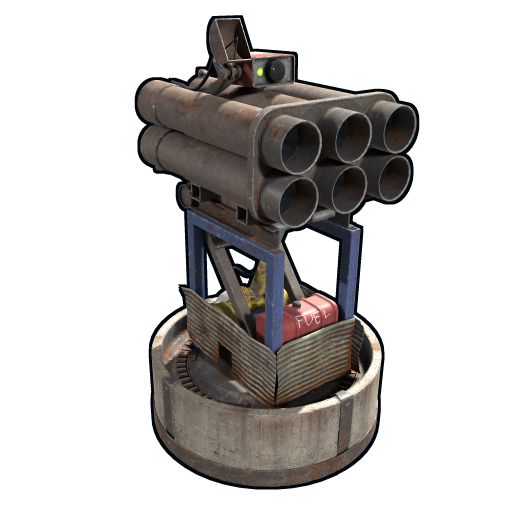 if compound walls extend
 - Vehicle bay with minicopter + horse + spare modular car
Trio power budget
Continuous: 60-80 rW (8 conveyors + 4 crafters + lights + turrets + smart alarms  ).
Peak (full smelt + greenhouse sprinklers): 500-600 rW.
).
Peak (full smelt + greenhouse sprinklers): 500-600 rW.
Source: 2 wind turbines on elevated pillars + 4 solar panels + 2 large batteries in parallel.
Clan compound — scale considerations
Past trio, you stop optimizing one base and start optimizing a compound:
- Main base (4x4 or larger) houses the core production
- External outbuildings: dedicated greenhouse, dedicated smelter, dedicated vehicle bay
- External TC
 bubbles extend the no-build zone
 - Compound walls push raiders 30+ meters from any structure (mortar mitigation)
- Compound walls now cost real upkeep (August 2026): high external walls carry a static 20% upkeep cost, so a big wall ring is an ongoing tax on your external TC — factor it in (see 20 — Tool Cupboard)
Output targets for a 5-person clan:
- 10,000+ scrap /hour with 3 farmers running parallel routes
- 1,500+ 5.56/hour from 2 dedicated ammo factories
- Full self-sufficiency on food, tea, ammo, repairs
The 5 biggest production mistakes
- Sprawling 4x4 base before WB3 . Build the 2x2, get to WB3 , then expand. Don't over-stone
 before you have industrial.
 - One large battery for 200+ rW peak load. Batteries cap at 100 rW output. Wire two in parallel for higher draw.
- One auto-sort network covering everything. Hit the 16-adapter cap fast. Split into 2-3 smaller networks.
- Smelting with wood furnaces past hour 12. Electric furnaces smelt 40% faster and don't need fuel — pure power.
- Greenhouse without temperature control in cold biome. Plants take stress damage, yield drops 30%. Add a heater
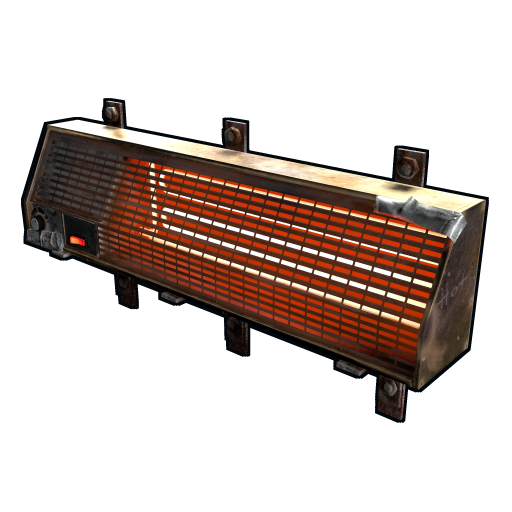 .
.
Defensive optimization — a start-to-finish breakdown
A base that out-produces the server is worthless if it gets opened on the first offline. Production and defense are the same optimization problem: you are spending a finite resource budget to make a raider spend more than your loot is worth. Every section below is framed as cost-per-sulfur-denied — the only metric that matters when an attacker is standing at your wall with a rocket launcher.
Wall layering for cost efficiency
Honeycombing — filling the triangle and square pockets around your core with extra walls — is the single highest-return defensive investment in the game. A raider who breaches your outer shell must then chew through every honeycomb wall in their path, and each stone wall layer adds roughly 5,600 sulfur (4 rockets) or 4,400 sulfur (2 C4) to the bill. Expanding your footprint with more rooms costs you upkeep on every tile; honeycomb costs you only the wall and forces a deeper raid.
The decisive rule: your base must never have a cheap side. Raiders probe all four faces and commit to whichever path reaches loot fastest. One un-honeycombed wall, one downgraded door frame, or one window left at stone undoes the other three sides entirely. Audit your base from the outside before you sleep and ask, "which wall would I shoot?" — then fix that wall.
| Layer | Material | Soft-side raid cost | Notes |
|---|---|---|---|
| Outer shell | Stone | ~5,600 sulfur / wall (rockets) | Cheap to maintain, soaks the first breach |
| Honeycomb 1–2 | Stone | ~4,200 sulfur / wall (soft side, 25% off) | Every layer is pure raid tax |
| Core / loot room | Sheet metal or armored | 8,000+ sulfur / wall | Upgrade before you log off — never sleep on stone core |
A fully honeycombed 2x2 with a metal-core loot room forces a raider through 3–4 walls — roughly 16,800–22,400 sulfur of explosives — before they touch your main storage. Keep buffer and honeycomb walls in stone to hold down upkeep, and spend HQM only on the handful of walls that directly enclose loot.
Loot-room placement vs the raid path
Place your loot room at the point that is geometrically furthest from every exterior wall, so no single breach line reaches it. The TC and loot-room walls should be the most upgraded surfaces in the building, and they should never sit flush against an outside wall — there must always be at least one honeycomb pocket between the loot and the sky.
- Centre-mass core. A loot room buried in the middle of a 3x3 forces a raider to commit to a long, expensive corridor before they know if the loot is even there.
- Split your loot. For trios and clans, never stack the whole wipe's sulfur in one room. Distribute it across two or more TC zones so cracking one bunker yields a fraction of the haul — this converts a one-night raid into a multi-day project most groups abandon.
- Decoy rooms. An empty, obvious "loot room" near the entrance burns a raider's first few charges on nothing and buys your raid-defense window time to arrive.
- Vertical separation. Putting loot a floor above or below the natural breach height adds a ceiling/floor to the raid path — another full charge set.
Embrasures and shooting-floor positioning
The embrasure cross-section diagram above shows the principle: a narrow metal slit gives the defender a wide outward firing arc while denying the attacker any angle back in. Mount embrasures on the inside of the window frame — this widens your shooting gap and keeps the plate between you and incoming fire. Pair a reinforced glass window with a vertical embrasure and a raider must spend roughly 8 rockets just to open that one cell.
A shooting floor — an open, railed level above your compound wall — is the other half of active defense. It gives you roof peeks, turret mounts, and both long- and close-range angles onto anyone laddering or rocketing your walls. Layered shooting floors with open frame windows approach 360-degree coverage of the approach. Build the shooting floor and its peeks into the design from the start; bolting them on later forces awkward angles and blind spots.
Auto-turret coverage arcs and how many you need
An auto turret draws 10 rW and detects targets within roughly 25–30 m. When idle it scans a 90-degree viewing cone; once it acquires a target it can track and fire across a much wider angle, but it still cannot see behind itself or through walls. The white V-shaped lines shown during placement are the detection field — aim that V down corridors, at door frames, and across the exact tiles a raider must stand on.
- Solo 2x2: 2–3 turrets — one covering the airlock, one or two covering the main breach faces.
- Duo / trio 3x3: 4–6 turrets — cover every exterior face plus the internal corridor leading to loot.
- Clan compound: 8–12+ turrets — overlap arcs so no approach lane is covered by only one turret, and stagger them so a raider clearing one still walks into another.
Always overlap turret arcs at choke points: a single turret is shot out or shielded easily, but two crossing arcs force the raider to break line-of-sight from both at once. Mount turrets where they themselves are hard to rocket — recessed into embrasure cells, behind low walls, or up on the shooting floor.
Electrical defense systems
Turrets are only one node in an electrical defense net. Wire them off a dedicated battery bank so a raider cutting your industrial power does not also blind your defenses, and budget one large rechargeable battery per ~100 rW of defensive load.
- Shotgun traps and flame turrets on the airlock and entrance corridor punish a raider's first push for almost no power cost.
- HBHF sensors wired into smart alarms tell you a body is inside even when you are off the server — critical for raid response.
- Tripwire-triggered turret power keeps turrets unpowered (and un-noticed) until a pressure pad or laser detector switches them live, saving battery and hiding your defense from a scouting raider.
- Heli/auto-turret split feeds ensure a fuse-pull or wire-cut on one circuit cannot dark the whole base.
Traps and area denial
Turrets do the loud work of base defense, but the cheapest sulfur a raider ever loses is to a trap they never saw. Traps are passive, deployable devices that punish movement through a tile — they cost nothing to "run" beyond the occasional ammo or fuel top-up, they need no targeting authorization, and they keep working while you are offline. The doctrine is layering: a trap rarely kills a prepared raider outright, but it slows, damages, or panics them onto the next thing in your kill chain. Place traps where a body must stand — airlock floors, corridor pinch points, ladder bases, and the obvious approach lanes to your door. The three covered below are the ones most players underuse. The shotgun trap / gun trap and the auto-turret are detailed elsewhere on the site and only cross-referenced here.
Flame Turret
The flame turret 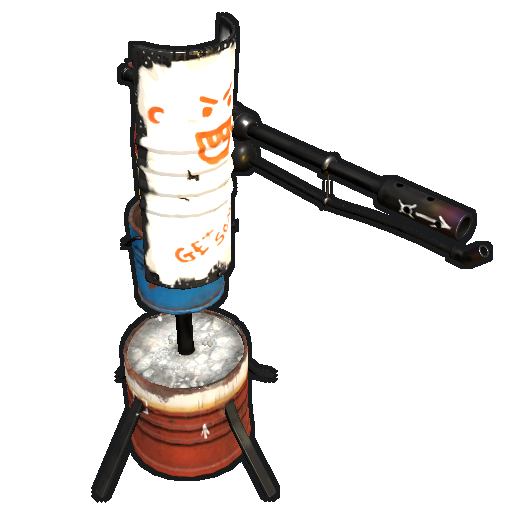 is an unpowered area-denial device with 300 HP that sprays a cone of fire when a non-authorized player enters its roughly 90-degree front arc. It reaches about 5.6 m (~1.9 foundations), burns Low Grade Fuel
  at about 30/minute while triggered, and holds up to 500 fuel — a single fill lasts a very long time because it only drains while actually firing. A target caught in the flames typically dies in 2–4 seconds if they do not retreat. It needs no electricity and no authorization menu: anyone without building privilege in its area is a target.
- What it is best at: sealing corridors, airlocks, and chokes where a raider has no room to side-step the cone. Fire also ignites and chews through any wood construction nearby, so pair it only with stone or metal.
- Placement: mount it on a wall facing down the airlock or the entrance corridor, angled so the cone covers the exact tile a raider lands on after the outer door. Two flame turrets facing each other across a one-tile corridor leave no safe pixel.
- Cost / fuel: crafts from 200 Metal Fragments , 2 Empty Propane Tanks, and 1 Gears
 . It is repairable, so a flame turret that survives a raid is reset for free.
 - Versus the shotgun trap: the two are complementary, not interchangeable. The shotgun trap delivers one burst of hitscan damage and then must reload — devastating against a single rush, useless if the raider waits it out. The flame turret deals sustained damage for the whole time a body stays in the cone, making it the better tool for denying ground and punishing a raider who lingers to chop a door. Run the shotgun trap for burst and the flame turret for duration.
Landmine
The landmine 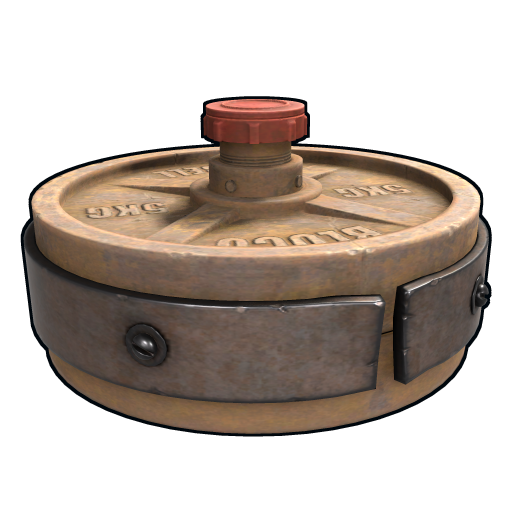 is a buried, single-use explosive that detonates when a player or vehicle moves over it, dealing about 100 damage within a roughly 3.2 m (~1.1 foundation) blast radius — enough to instantly kill or near-kill any unarmored or lightly armored attacker. Once it triggers it is consumed and must be replaced; it is not repairable. A still teammate near a triggered mine has a small chance to disarm it, so mines reward placement a raider cannot anticipate.
- What it is best at: mining the predictable approaches — the strip of ground in front of your main door, the base of a likely raid-tower spot, narrow gaps between rocks a raider must funnel through, or a compound gateway. It is a one-shot ambush, not a sustained defense.
- Placement: bury mines slightly off the dead-centre line where an alert raider walks; people hug walls and cut corners, so the corner tile of a doorway often catches more feet than the middle. Spread them rather than clustering — one mine per choke denies that lane.
- Cost: crafts from 50 Metal Fragments and 30 Gun Powder per mine. Treat each as ammunition you will lose — cheap enough to seed an approach, expensive enough not to carpet the whole map.
Bear Trap
The bear trap 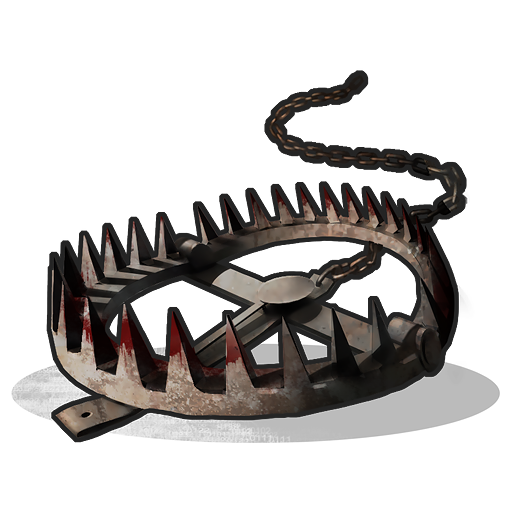 (in-game "Snap Trap") is the cheapest area-denial device in the game: a ground snare that, when stepped on, deals about 51 instant damage plus a 30-point bleed and very often wounds the victim outright, freezing them in place for several seconds while they break free. Its hitbox slightly overreaches the trap model, so it can be tucked partly behind a wall or door frame and still catch a passing leg. It is repairable and re-arms after it snaps.
- What it is best at: slowing — not killing — attackers and looters in corridors, on stair landings, and along the loot route, buying you the seconds needed for a turret or a peek shot to finish the job.
- Placement: lay traps on the floor tile immediately past a door or at the top of a ladder, where a raider's momentum carries them onto it before they can react. Stagger several down a corridor so clearing one drops them onto the next.
- Cost: crafts from just 50 Metal Fragments and 1 Gears — cheap enough to litter every loot route and entrance.
| Trap | Craft cost | HP / durability | Damage | Best role |
|---|---|---|---|---|
| Flame Turret | 200 metal frags, 2 empty propane tanks, 1 gears | 300 HP, repairable | Sustained burn, ~2–4 s to kill in cone | Area denial in corridors and airlocks (duration) |
| Landmine | 50 metal frags, 30 gun powder | Single-use, not repairable | ~100 explosive in ~3.2 m radius | Ambush on approaches and doorways (one-shot) |
| Bear Trap (Snap Trap) | 50 metal frags, 1 gears | Re-arms, repairable | ~51 hit + 30 bleed, frequent instant wound | Snare and slow attackers on loot routes |
| Shotgun Trap | see Building | Repairable | One hitscan burst, then reloads | Burst punish on a first rush |
Layering them together: traps are the connective tissue between your walls and your turrets. A worked example for an airlock: a bear trap on the floor tile behind the outer door snares the raider, a flame turret cone covers that same tile for sustained damage while they are stuck, and a landmine seeds the ground just outside the door for anyone who tries to tower or rush in. None of these wins the raid alone — but each one costs the attacker time, health, and meds, and a raider bleeding and burning in your airlock is a raider not focused on your loot room. Pre-place traps during the build phase alongside turrets so arcs, cones, and trigger tiles are deliberate rather than improvised mid-wipe.
Peek and airlock design
An airlock — two doors with a sealed space between — means a raider who blows your outer door is still standing in a kill-box facing a second door, not inside your base. Build the airlock so the inner and outer doors are never open at the same time, and add a peek window or embrasure into the airlock so you can fire on anyone trapped in it.
- Offset the doors. An L-shaped or offset airlock denies a raider a straight rocket line from the outer door to anything valuable.
- Gatehouse peeks. A wall-frame-and-window combo lets you check who is at the door and shoot first without exposing your body.
- Flank exit. A second, hidden exit from the airlock or compound lets you slip out and flank raiders or grab their dropped explosives mid-raid.
- Door upgrades. Garage doors resist melee and are cheap; armored doors cost more upkeep but force C4. Match the door tier to the value behind it.
Anti-online vs anti-offline optimization
The two raid types demand opposite optimizations, and you cannot fully cover both — decide which your server's population pushes you toward.
| Threat | Optimize for | Key measures |
|---|---|---|
| Online raid | Active defense — make the fight expensive | Shooting floors, peeks, embrasures, overlapping turrets, fast in-base movement, a stocked raid-response window |
| Offline raid | Passive defense — make the time/sulfur cost absurd | Deep honeycomb, split loot, metal/armored core, decoy rooms, more wall layers than the loot is worth |
Practical balance: build the honeycomb and split-loot core for offline protection first (it works while you sleep), then add peeks and shooting floors for the hours you are online. If your group cannot reliably defend, accept that you are an offline target and over-invest in layers.
Decay and upkeep efficiency
Upkeep is the recurring tax on your defense. The tool cupboard drains roughly 10% of total building cost every 24 hours: stone walls cost about 6 stone/day each, sheet metal about 8 metal fragments/day, armored about 1 HQM/day. A small 2x2 stone base burns on the order of 900 stone per day — about 15 minutes of mining or one quarry cycle.
- Stone the buffer, metal the core. Keep honeycomb and non-critical walls stone to slash upkeep, and reserve metal/HQM for the walls directly enclosing loot.
- Don't over-build. Every extra room you will not use is permanent upkeep with no defensive return. A tight, deep base beats a sprawling, shallow one.
- Stockpile a buffer. Keep 2–3 days of upkeep in the TC so a missed login does not collapse your walls. If the TC empties, stone structures begin to decay after about 5 hours, metal after ~8, armored after ~12.
- Overlapping TCs. Place secondary cupboards whose radius overlaps the main TC so a raider cannot simply claim build privilege and disable your decay protection.
Common optimization mistakes
- Leaving a cheap side. One stone window or downgraded door on an otherwise metal base hands raiders a discount path — they will find it.
- Loot stacked in one room. A single breach that yields the whole wipe is the worst possible loot layout.
- Sleeping on a stone core. Always upgrade loot-room and TC walls to sheet metal or armored before you log off.
- Turrets with no overlap. A lone turret is shot out or shielded in seconds; arcs must cross.
- No raid-response stash. An online raid you cannot counter because your guns and meds are in the breached room is a lost raid — keep a defense kit near the peek.
- Honeycomb with gaps. An empty triangle pocket is a free wall for the raider. Fill every pocket.
- Ignoring upkeep. A base that decays open while you are offline did not need to be raided at all.
Defensive pro tips
- Walk your own raid. Before logging off, mentally raid your base from each side and count the charges to loot — the cheapest path is your true defensive rating.
- Make the loot not worth the sulfur. If a clean raid costs 20k sulfur and your loot is worth 8k, a rational raider walks away. Defense is economics.
- Hide the value. A plain, small, ordinary-looking exterior draws fewer raiders than an obvious fortress full of turrets advertising loot inside.
- Pre-place defensive deployables. Position turrets, traps and shotgun traps during the build phase so wiring and arcs are clean, not improvised mid-wipe.
- Keep a parallel battery bank for defense only so industrial draw or a cut wire never darkens your turrets.
- Run smart alarms on the front door and raid window so you get a phone alert the instant a raid or counter-raid begins.
Quick optimization checklist
When your base feels slow, run through this list:
| Symptom | Likely cause | Fix |
|---|---|---|
| Scrap pile not growing |
Not running scrap tea before monuments |
Pre-craft Pure Scrap Tea |
| Always out of ammo | Crafter ingredients run out |
Auto-sort sulfur /charcoal  to crafter feed to crafter feed |
| Furnace idle |
Wood blocking the input slot |
Filter input conveyor to ore only |
| Lights flicker at sunset | Solar drop, no battery buffer |
Add a large battery |
| Conveyors lagging |
Hitting the 5-second tick on too many items | Add a second parallel conveyor |
| Greenhouse yield low | Wrong gene strings or under-watered | Audit gene strings, set sprinkler timer  |
| TC empty mid-wipe |
Forgot to feed it | Set up an industrial pipe  from main storage to TC inventory from main storage to TC inventory |
Pro tips
- Build the industrial network LAST. Place all containers and furnaces first, then wire pipes once everything is positioned.
- Label every conveyor 's filter with a sign. Mid-wipe you'll forget which one does what.
- Use Rust+ smart alarms on the front door, raid response window, and any pipe-fed crafter that might run dry.
- One large battery per 100 rW of peak load. Wire in parallel for higher current.
- Greenhouse over a campfire
 room stays at growth temperature even in snow biome.
 - Drink Crafting Tea + Scrap Tea before extended base sessions — the 35% craft time reduction stacks with everything.